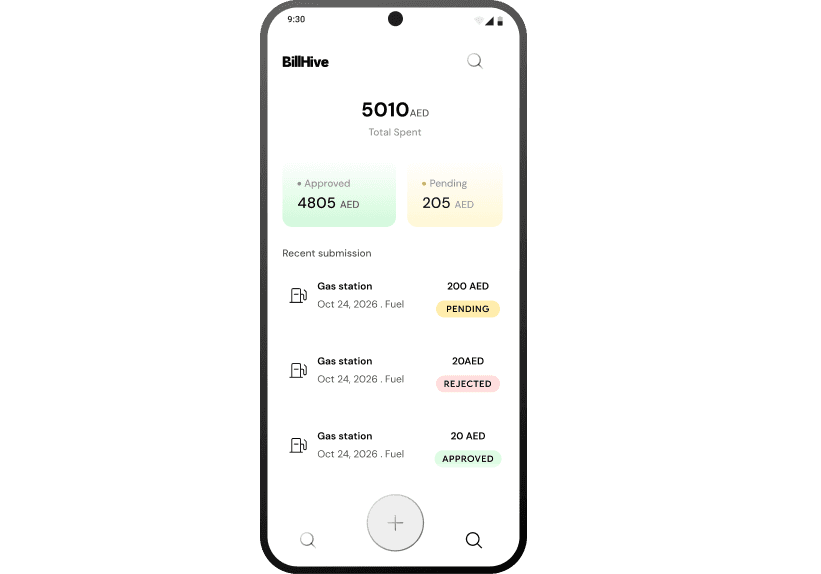
Every day, 47 photos were being sent on WhatsApp. Zero of them were tracked.
01 - CONTEXT
Fleet drivers across the UAE were photographing receipts at fuel stations and parking lots, then firing them off into a WhatsApp group. Managers were manually typing each one into Excel. Duplicates slipped through. Bills went missing. Nobody knew the real cost of running the fleet until the month was already over.
"I send the bill. Then I wait. Then I call."
Vineeth, Driver
02 - PROBLEM DISCOVERY
The wrong tool doing the right job
WhatsApp was never built for expense submission- but it was the path of least resistance. Drivers already had it. It supported images. It felt instant. Managers had no better option, so they accepted the chaos.
The real problem wasn't WhatsApp. It was the complete absence of a purpose-built tool for non-desk, field-level workers.
Who is the primary user?
Primary: Driver
(Mobile app user in the field)
Secondary: Manager
(Web or mobile dashboard for review and approval)
What is the main user problem?
Driver
No confirmation after sending bills. Calls the manager to check. Bulk-uploads 10 bills at night. Receipts get lost or damaged.
Manager
WhatsApp flooded with images. Manual Excel entry per bill. No duplicate detection. No audit trail.
03 - RESEARCH & INSIGHTS
The mental model conflict
The driver thinks of bill submission as a communication act; send a message, wait for a reply. The manager thinks of it as a data processing task; receive image, extract, enter.
These two mental models are completely incompatible. Any solution has to feel like a simple send for the driver while automatically becoming structured data for the manager.
15% manual Entry error rate
5–10 min per bill (driver + manager combined)
No existing tool for this workflow
WhatsApp deeply habitual
Duplicate bills go undetected
Zero audit trail today
04 - DEFINE & FRAME
How might we make bill submission as fast as sending a WhatsApp and give managers structured data automatically?
Two users. Two jobs to be done. The driver needs to offload a receipt in under 60 seconds, mid-shift, with one hand. The manager needs a pre-filled, one-tap approval queue - not an inbox of images.
05 - IDEATION AND DESIGN DECISIONS
Three options considered
A WhatsApp bot was explored - zero install friction, but it doesn't fix the manager's problem.
A Progressive Web App was tried - no App Store barrier, but camera access is unreliable on Android.
A dedicated native app won: full control over UX, reliable camera, proper status tracking, and a clean manager dashboard. The trade-off was requiring an install - mitigated by extreme simplicity on first open.
Critical design decision: the camera opens on app launch. No menus, no navigation. The core action is the home screen.
06 - USER FLOW
Driver: 3 steps.
Manager: 1 tap.
Driver
Open app > camera opens immediately
Photograph the bill
OCR extracts details > confirm & submit
Push notification when approved or rejected
Manager
Open dashboard > pending bill queue
See auto-extracted: amount, vendor, date, driver
Tap Approve or Reject (add note if rejected)
Bill enters expense record automatically
07 - KEY DESIGN DECISIONS
What was intentionally kept and removed
Removed Friction
Long forms. Navigation before camera. Manual data typing. Status ambiguity after submission.
Kept Intentionally
A brief OCR confirmation step before submit - drivers own the data accuracy, protecting the company from blind OCR errors.
08 - IMPACT & METRICS
From 10 minutes to 60 Seconds
<60s
Driver submission time
(5–10 min)
<2%
Entry error rate (from 15%+)
~80%
Reduction in follow up calls ( Expected)
Duplicate detection, full audit trail, and exportable records make the finance team's job possible for the first time. The manager's WhatsApp is quiet. The driver knows their bill status without calling.
case study.
Thanks for reading